Golden Ratio Rectangles 01
d/dx artd/dx art constructs visual harmony through the rigorous logic of geometry, nesting shapes that mirror the mathematical rhythms of the natural world. This piece explores the recursive beauty of the golden ratio, where every rectangle and square exists in a precise, interlocking dialogue with the whole.
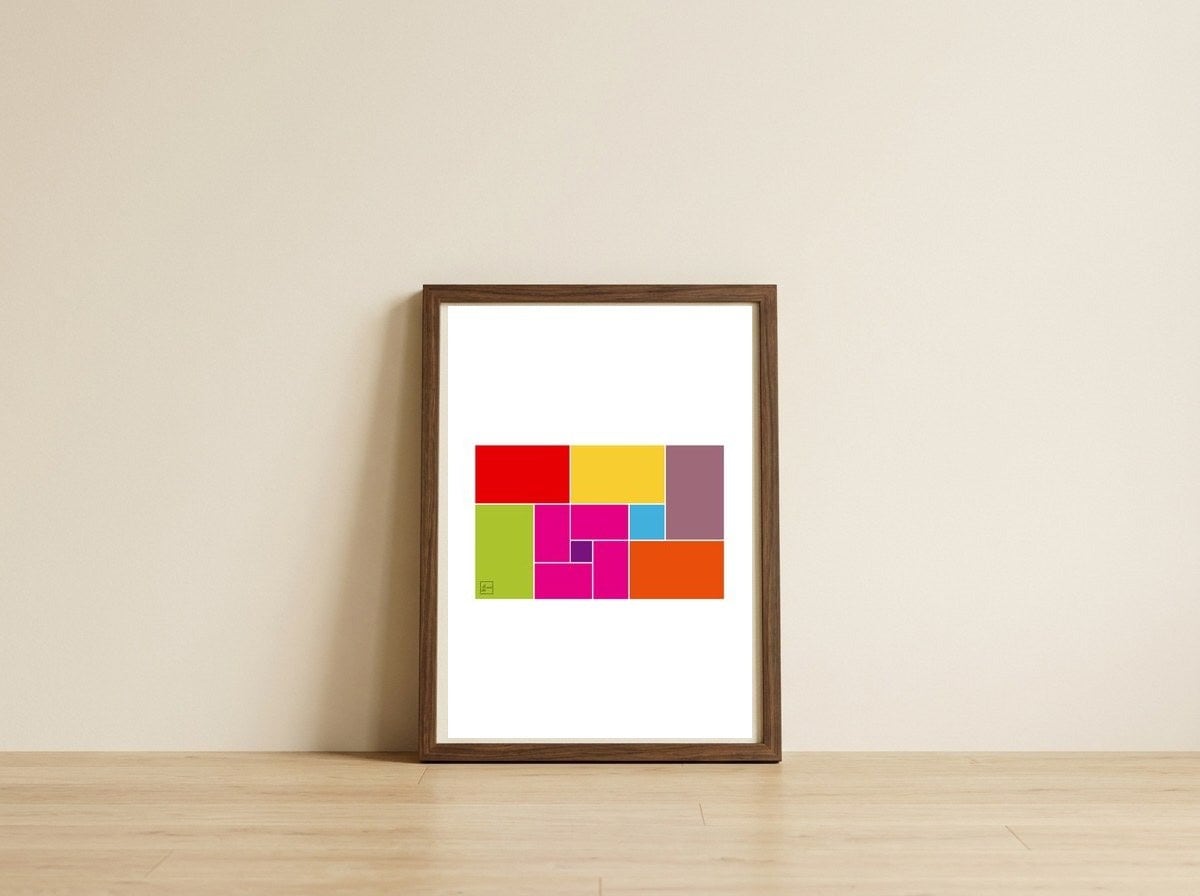
Golden Ratio Rectangles 01
d/dx art constructs visual harmony through the rigorous logic of geometry, nesting shapes that mirror the mathematical rhythms of the natural world. This piece explores the recursive beauty of the golden ratio, where every rectangle and square exists in a precise, interlocking dialogue with the whole.
35 × 28 cm · about ⅕ the width of a 3-seat sofa
A meaningful share of this purchase goes directly to d/dx art.
Every Arthaus piece supports a living artist.
Golden Ratio Rectangles 01
d/dx art
Art Analysis
From the artist, d/dx art
One of the fascinations of working with shapes based on the golden ratio is the way things nest together in such harmonious ways. This rectangle is a case in point. Take a rectangle where the relationship between the sides is the strange value called ‘the golden ratio’. If you want to work it our for yourself, it’s the ratio of a/b where a/b = (a+b)/a. It’s not difficult to solve that equation and come up with a value involving the square root of 5 but Instagram comments don’t sit comfortably with maths notation. It’s a number that can’t be expressed exactly but it’s around 1.618 and is labelled ϕ. What’s special about the golden ratio is that 1/ϕ = ϕ-1 (~0.618) and consequently ϕ*0.618 = 1. So the short side of the rectangle is ~0.618 the length of the long side. The smaller rectangles have sides which relate in the same way but their long side is ~0.618 times the length of the short side of the big rectangle. That done, all that remains is to fit together combinations of the smaller rectangles. There will always be a couple of squares left somewhere in the mix but the interesting thing is that every side length within the design is related in some way to every other by the golden ratio, the foundation of the Fibonacci sequence. Extra tags: mathematics, maths, geometry
The Recursive Harmony of the Golden Ratio
This work is a deep dive into the properties of ϕ, the irrational number approximately equal to 1.618 that governs the golden ratio. By applying the equation where the ratio of the sum of the sides to the longer side equals the ratio of the longer side to the shorter, the artist creates a landscape of nested forms. Each smaller rectangle maintains this exact proportional relationship, with its longest side measuring roughly 0.618 times the length of the larger rectangle's short side, ensuring that every line in the composition is mathematically linked.
The resulting pattern is a complex arrangement of rectangles and lingering squares that illustrates the foundation of the Fibonacci sequence. Rather than a static grid, the design feels like a living system where every individual component relates back to the total area. It is an exercise in structural balance, demonstrating how a single mathematical value can generate infinite, harmonious variations within a graphic space.
The piece translates the algebraic equation for the golden ratio into a visual language of nested geometric shapes.
The composition relies on the repetitive application of ϕ to create a self-similar arrangement of rectangles.
The work utilizes clean lines and exact proportions to explore how mathematical notation can be expressed through visual form.
Free Shipping
On all framed orders
100-Day Guarantee
Love it or return it
Gallery Quality
Museum-grade materials
Artist-Direct
Fair pay, every piece
More to Discover
More from d/dx art
ArtistMore of d/dx art’s work, hand-picked from the collection.