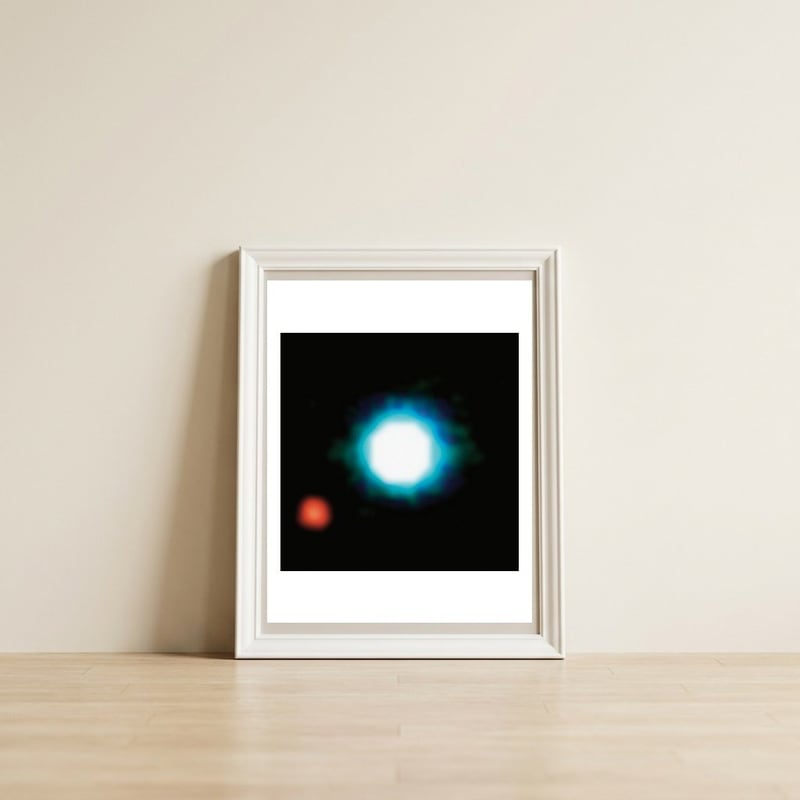
First Image of a Blackhole (Print Only)

European Southern Observatory

The European Southern Observatory captures the invisible by synchronizing a planet-scale array of radio telescopes to render the very edge of existence. This image reveals the glowing ring of matter circling the supermassive black hole at the center of Messier 87, a shadow cast against the light of the event horizon.

First Image of a Blackhole — framed, leaning against the wall

Styling images show a frame. Print sold unframed.

European Southern Observatory

First Image of a Blackhole (Print Only)

Format
£23.99
WALL ELEVATION

20 × 25 cm · about ⅛ the width of a 3-seat sofa

Size
Borders & Matting
Paper Type

A meaningful share of this purchase goes directly to European Southern Observatory.

Every Arthaus piece supports a living artist.

Free shipping
100-day guarantee
Gallery quality
Secure packaging

First Image of a Blackhole (Print Only)

European Southern Observatory

Art Analysis

From the artist, European Southern Observatory

The Event Horizon Telescope (EHT) — a planet-scale array of eight ground-based radio telescopes forged through international collaboration — was designed to capture images of a black hole. In coordinated press conferences across the globe, EHT researchers revealed that they succeeded, unveiling the first direct visual evidence of the supermassive black hole in the centre of Messier 87 and its shadow. The shadow of a black hole seen here is the closest we can come to an image of the black hole itself, a completely dark object from which light cannot escape. The black hole’s boundary — the event horizon from which the EHT takes its name — is around 2.5 times smaller than the shadow it casts and measures just under 40 billion km across. While this may sound large, this ring is only about 40 microarcseconds across — equivalent to measuring the length of a credit card on the surface of the Moon. Although the telescopes making up the EHT are not physically connected, they are able to synchronize their recorded data with atomic clocks — hydrogen masers — which precisely time their observations. These observations were collected at a wavelength of 1.3 mm during a 2017 global campaign. Each telescope of the EHT produced enormous amounts of data – roughly 350 terabytes per day – which was stored on high-performance helium-filled hard drives. These data were flown to highly specialised supercomputers — known as correlators — at the Max Planck Institute for Radio Astronomy and MIT Haystack Observatory to be combined. They were then painstakingly converted into an image using novel computational tools developed by the collaboration. Credit: EHT Collaboration

Free Shipping

On all framed orders

100-Day Guarantee

Love it or return it

Gallery Quality

Museum-grade materials

Artist-Direct

Fair pay, every piece

Gallery Walls

Complete the Wall

This piece is part of a wall our team put together — shown with the works chosen to sit beside it.

About the Artist

European Southern Observatory

View Artist Profile